"The home is the center of life. It is a refuge from the grind of work, the pressure of school, and the menace of the streets. We say that at home, we can “be ourselves.” Everywhere else, we are someone else. At home, we remove our masks.— Matthew Desmond · Evicted: Poverty and Profit in the American City ↗
The home is the wellspring of personhood. It is where our identity takes root and blossoms, where as children, we imagine, play, and question, and as adolescents, we retreat and try. As we grow older, we hope to settle into a place to raise a family or pursue work. When we try to understand ourselves, we often begin by considering the kind of home in which we were raised."
Now · Requation
- Condos as the Third Option America defaults to two housing choices: buy a single-family home or rent forever. Neither works for the families being priced out of both. Requation is building a platform that puts condominiums on the map as a real, visible, searchable alternative — ownership without the land cost, community without the landlord.
- Every Mom-and-Pop on the Map The dry cleaner that's been on the corner for 30 years. The alterations shop. The family-run hardware store. These businesses are the connective tissue of a neighborhood — and most of them are invisible online. Requation gives every one of them a map pin, a URL, and a digital address that makes them findable. Visibility is infrastructure. Without it, the chains win by default.
- Neighborhood Identity, Not Just Listings A street is more than its real estate. Requation maps the businesses, the history, and the character of a neighborhood — so that when someone is deciding where to live, they're choosing a community, not just a square footage.
The Work · 2008–2017
As a first-time immigrant, I know the terror of homelessness — not as a statistic, but as a feeling you carry. That is why, since 2008, Martin's Way has taken on the properties nobody else would touch: buildings gutted by methamphetamine operations, stripped of copper wire by thieves, abandoned to crime and decay until the neighborhood absorbed the message that nobody cared. We disagreed.
The method was Adaptive Reuse — the discipline of working with what a building still has rather than erasing what it lost. In a gutted building, most developers see a teardown. We saw a skeleton worth saving. Every door, window, light fixture, and structural element that could legally be reused was reused. No demolition waste. No construction noise for six months. No pollution from materials that should never have been discarded. Faster, cheaper, and better for the street that had to live with it.
- West Seattle · 2008–2015 Delridge Way SW — meth-damaged and copper-stripped properties rehabilitated and returned to productive use. Seven years of sustained investment in one of West Seattle's most overlooked corridors.
- White Center · 2015 Just outside the Seattle city limits — which put it outside most people's attention. Adaptive Reuse of blighted property in a neighborhood that had been written off. The Cocoon mural by Jeff Jacobson followed.
- East Cleveland · 2015–2017 One of the most disinvested urban corridors in America. Same model: find what the building still has, build from there, leave the block better than you found it.
Delridge Way SW · West Seattle · 2008–2015
Delridge Way SW was Martin's Way's first street. One of West Seattle's toughest corridors — we invested in building rehabilitation, worked with SDOT on streetscape improvements, and helped anchor the kind of long-term community presence that makes a block worth fighting for.
The murals matter. Art on a wall is a declaration: this place has value. The Marcus Joe mural on Delridge Way SW and the Cocoon mural by Jeff Jacobson in White Center are not decoration — they are arguments.
People's Republic of Music · White Center · 2015
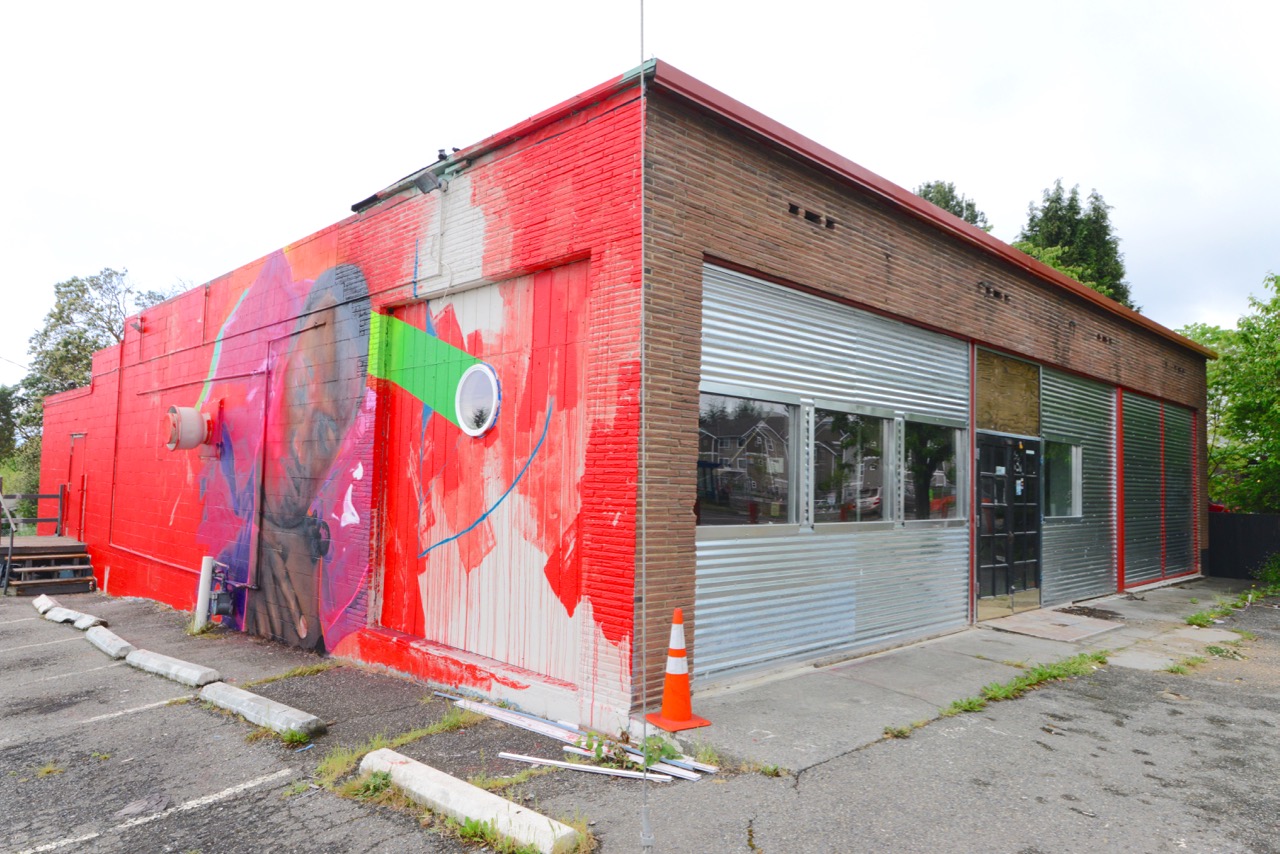
White Center sits just outside the Seattle city limits — which means it sits just outside most people's attention. PROM (People's Republic of Music) was a bet on that neighborhood: that idealism, properly organized, is a legitimate community development strategy. The West Seattle Herald covered it in 2015. The Cocoon mural is still there.
Streets change when people decide they should. Not before. The decision is the hard part.